
Language is a space in which we encounter others.
Both our thinking and communication unfold within it.
Every foreign language is, at first, a world we do not understand. We stand at its threshold, unsure which direction to take. We lose our way because we do not yet know its rules.
Once we begin to grasp them, the space starts to open up — and with it, the possibilities it offers.
My role
in this space is to define a goal and map the path towards it.
A different one for each student.
Without shortcuts and without avoiding what matters.
I set milestones and make sure students do not reach dead ends or go round in circles.
I teach the rules that govern movement within this world and guide students until they have truly internalised them.
The aim is for them to be able to move within it independently
— without me.
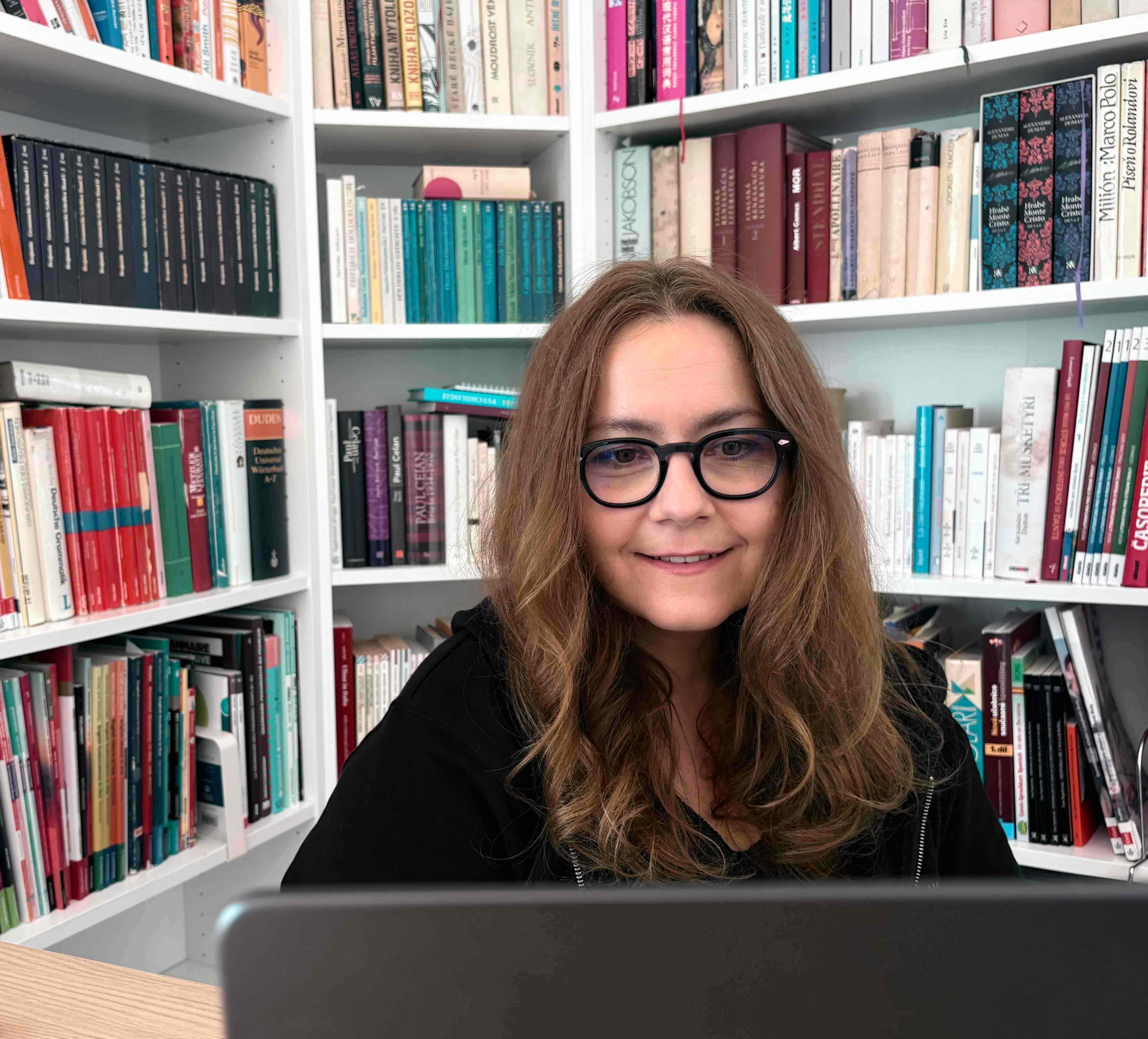
I come from Prague. I graduated from the Academic Grammar School, Štěpánská, Prague. At the time of my final exams, I spoke German, Spanish and English. At the Faculty of Arts, Charles University, I studied a double major in German Studies and Linguistics (Phonetics). In 2000–2001, I studied at Heidelberg University (DAAD scholarship). I completed my Master's degree in 2005 with a thesis supervised by Professor Miroslav Petříček on the concept of translation in the philosophy of language. The focus of my studies was the philosophy of language, linguistics and literary theory. From 2009 to 2012, I studied Sinology at the Faculty of Arts, Charles University, including a scholarship stay at Tianjin Normal University in Tianjin, China (2011–2012).
I have been teaching languages since 1998. I have worked both for language schools and privately. I have translated specialist, literary and historical texts, interpreted conferences and meetings, and provided proofreading, including academic work.
From 2008 to 2015, I worked at Sun Microsystems and Oracle.
In 2013, I taught English and German at Nankai University Binhai College in Tianjin, China.
In 2014, I founded a language studio in Prague's Malá Strana district. Since then, I have specialised in German for doctors, diplomats and management. I introduced a hybrid teaching model combining in-person and online lessons.
Since 2017, I have been preparing students for entrance exams to selective grammar schools (CERMAT).
From 2017 to 2019, I taught German, English and Czech for foreigners in the English-language programme at the University of Finance and Administration in Prague.
Since 2020, I have been working exclusively online.
Tuition works when:
You participate actively
You respect the process
You have a clear goal
Frequently Asked Questions
The more thoroughly you complete the initial enquiry form, the sooner we can move to the teaching itself.
With complete beginners, I explain how the language is structured and how to approach it: from pronunciation and basic sentence patterns to the gradual expansion of vocabulary. I show the logic of the grammar — what builds on what, which areas tend to be more demanding and in what order it makes sense to proceed. I recommend suitable course materials and we establish a realistic timeframe. In most cases, we already begin working on pronunciation and the first sentences you will be able to say about yourself by the end of the lesson.
With false beginners (students returning to the language after a gap) and more advanced students, we begin with a conversation in the target language. This serves both as an initial diagnostic and as a first introduction. Based on it, I propose specific next steps — typically a revision of a grammatical area in which errors recur. We create model sentences, practise them and set the next stage of the plan according to priorities.
You leave each lesson with a concrete skill and a clear task for how to practise it further.
Before the first lesson, the student receives a sample test. They complete it directly in the test paper and add notes, including questions or question marks next to tasks they do not understand or have not yet covered. They also record when the time limit ended and how much additional time they needed, if any.
This means that I begin the first lesson with concrete data. I know which areas need to be explained, while also looking at the type of error: whether it results from missing knowledge, a misunderstanding of the task or an ineffective approach.
We immediately establish effective strategies for individual task types, test them on similar examples and record them for use in later tests.
I explain why every task needs a clear strategy. We also work on time management: how to allocate time and where not to lose it. From the outset, I teach a precise approach to managing the test under time pressure. I also explain why the test needs to be understood as a whole and why full-length practice must begin early enough.
Progress is directly proportional to the time you devote to the language.
What is commonly described as "talent" is more often a combination of motivation, working methods, guidance and context — in other words, conditions that make it possible to use the language in situations that are as authentic as possible.
Progress should be noticeable after every lesson. Over the course of several months, it becomes measurable; in intensive courses, often within weeks.
I work according to the pace of the individual student, not the coursebook. I set the process at the highest level that is realistically manageable at a given moment. When a student is struggling to keep up, I adjust the pace. I do not, however, slow progress down artificially.
Reaching B1 within six months is therefore not unusual.
Progress is not always obvious from your own perspective. When you are fully immersed in the work, you do not necessarily have the distance needed to assess it accurately.
That is part of my role: I provide objective feedback. It is in my interest that you understand your progress, because only then does our work together make sense. We therefore assess your level regularly and measure development over time. When the outcome is an examination or certificate, this is even easier to track through scores and percentages.
There are also more natural signs: over time, you will feel more comfortable, less tired and more relaxed in the language.
The goal is for you to move through the language naturally — for it to become a space in which you can find your way independently.
Tuition is designed individually.
Lessons may take place daily in shorter blocks of 20–30 minutes, once or twice a week in a standard 60-minute format, or as longer sessions of 120–180 minutes.
The arrangement always depends on the goal, the available timeframe and your practical circumstances.
What matters most is regularity and work between lessons.
Based on your goal, I establish the minimum amount of work that still makes sense, the ideal range and the maximum level of effort that will be effective in your particular situation.
The time required always depends on the goal and the available timeframe.
As confidence in the language grows, so does the willingness to work. Tuition then naturally becomes more intensive and progress accelerates.
Yes. I enjoy teaching complete beginners.
From the outset, I have a clear overview of their vocabulary and grammatical knowledge, which allows me to establish a consistent system without gaps or the need for later corrections.
Tuition is systematic from the first steps and designed to prevent the formation of communication blocks.
From the first lesson, we use the language actively. The aim is not passive knowledge, but the ability to formulate your own sentences.
Our work together does not depend on what you have done in the past, but on the approach you are prepared to take now.
What matters is your willingness to invest time and effort, work with mistakes, accept guidance and remain open to new methods.
This can be learned — just like the language itself.
When the previous approach has not worked, we change it.
Lesson cancellations have clear rules. It is in both parties' interest to respect them.
When late cancellations occur repeatedly, I will generally consider ending the collaboration.
In the event of illness or a serious situation, I deal with matters individually — usually by arranging a replacement lesson. Maintaining a workable, reliable collaboration matters more to me than applying rules mechanically.
Yes, I also teach at weekends.
Weekend lessons are in high demand, so they need to be scheduled in advance. The timetable and price depend on the individual study plan.
Yes.
Assignments and exercises are part of the overall process. Once we agree to work together, it is necessary to follow the plan, including work outside the lessons.
During lessons, we focus on the areas where you genuinely need my direct input. The rest is assigned for independent work.
I provide objective feedback. I do not overstate results or language level.
I am also available outside lessons for consultations, corrections of assignments and brief explanations when something is unclear.
Yes, depending on the agreed study plan.
Many of my students are managers, doctors, diplomats and business owners whose working schedules do not allow for a fixed timetable. I therefore also offer arrangements with flexible lesson booking.
Even with a flexible schedule, however, it is necessary to maintain the agreed weekly volume of work in order to preserve continuity and momentum.
I am not tied to a single coursebook. I have an extensive library, which I expand continuously.
We select materials together. Based on the goal and the individual student, I propose suitable options, explain their logic and agree the final choice with you. If it becomes clear during the course that a selected resource is not suitable, we adjust it.
I also work with materials brought by students. When they are not appropriate, I explain why and propose an alternative.
I combine traditional resources with digital tools, including AI. Online tuition allows materials to be shared immediately and concepts to be explained clearly and visually.
Where high-quality materials from respected authors, publishers or institutions are available, we use them. In other cases, I create examples and exercises specifically for the lesson.
Depending on the level, we begin with conversation. I aim for active language use even at the lowest levels. Topics follow the logic of the agreed goal.
I deliberately lead the lesson as an unscripted conversation. It is not a practice dialogue or role-play, but genuine communication with real content, in which the language is used rather than simulated.
The conversation has cognitive momentum: the student responds, thinks and formulates their own sentences. The aim is not a one-off exercise, but for something to remain after the lesson — an understanding, a formulation and a structure that can be used again.
In the next part of the lesson, we work systematically according to the plan. The student receives ongoing feedback, new expressions are recorded and grammar is explained directly in context so that it can be used immediately.
I teach different ways of expressing meaning: compensatory strategies where needed, and precision where appropriate. The aim is fluent, effective communication.
At the end of the lesson, we set concrete tasks for the next stage of work.
Yes. I work with specialist terminology particularly in medicine, psychology, law and selected areas of technology.
This experience is based on translation work as well as work with specialist texts. I have worked as a senior business analyst in IT corporations and collaborate with companies in financial technology, so I also understand this area from practical experience.
I am used to carrying out research and expanding my knowledge according to the needs of a specific subject. I see this as part of my work.
Yes, I teach children. I generally recommend online tuition from around age eight.
The key factors are cooperation from parents, suitable technical equipment, clear organisation of materials and the child's own approach to learning. I expect parents to engage actively and work with feedback — not simply to arrange the lessons.
Online learning also has advantages: children can send me dictations and exercises, we share screens and work with materials in real time. They see procedures clearly in front of them and can return to them later.
Progress always corresponds to how the child works, both during and between lessons. When they look for shortcuts — for example by using answer keys or AI — the collaboration cannot work. The issue is not the online format, but the approach to learning.
At the beginning, I assess whether the child is ready for this form of collaboration. When they are not, I recommend waiting before starting tuition.
For foreign-language learning, the period around the ages of nine to ten is particularly effective. Progress can be rapid, and reaching B1 or B2 within a matter of months is not unusual. I recommend regular assessment through recognised certificates so that children become familiar with examination formats. This is also beneficial in learning to manage stress and performance anxiety.
Yes. I have worked with children, adolescents and adults with specific learning needs, particularly dyslexia, dysorthography, ADHD and autism spectrum conditions.
The approach is always individual. I look for a way of working that is effective for the particular student and adjust it continuously in response to feedback.
It is important that I know about specific learning needs in advance whenever possible, either from parents or directly from the student. They will reveal themselves during tuition sooner or later, and early information allows an effective approach to be established from the beginning.
I am not a special education teacher. For that reason, I approach tuition flexibly and without fixed assumptions or pre-set schemes.
These collaborations have been successful both in foreign-language tuition and in CERMAT preparation.
You can tell from your approach to learning.
Working with me is best suited to a growth mindset: the belief that abilities can be developed through learning and practice; a willingness to treat mistakes as information; the readiness to adapt learning strategies when needed; and a focus on the process, not only the result.
If, by contrast, you see ability as fixed, tend to rationalise mistakes or protect your performance rather than improve it, this way of working may not initially be the right fit for you.
At the same time, I believe that learning habits and mindset can also develop. We can learn how to learn.
Online tuition is efficient and time-saving. It allows materials to be shared immediately, texts to be worked on in real time and concepts to be explained clearly and visually. The student sees the process, not only the final answer, and leaves each lesson with organised supporting materials.
There is no travel time, and lessons can be integrated easily into a working day. Online tuition also makes brief consultations outside lessons more accessible.
I have taught online for many years, alongside in-person tuition, and have worked exclusively online since 2020. In my experience, the results are comparable to — and often better than — in-person tuition. Students cancel less frequently, work more consistently and benefit from individually tailored lesson lengths and greater flexibility.
The only disadvantage is technical: reliable internet access and suitable equipment are necessary.
The format itself is not limiting. What matters is the way the work is done.
My method is designed from the outset to identify an approach that works for the individual student.
At the beginning, we agree on a plan and use the first lessons to test whether this way of working makes sense for you. Timely feedback is essential: any doubts or concerns need to be named early.
The aim is not to make one teaching style suit everyone, but to establish a form of collaboration that works.
Work between lessons is part of the collaboration.
At the beginning, we establish a plan that reflects your realistic capacity. With time-constrained professions, I am used to concentrating as much as possible into the lesson itself, so that tuition remains substantial and produces visible results even with a smaller time commitment.
Ideally, however, we find at least short periods of time between lessons. For this purpose, I create shorter exercises and flashcards and show students how to use them in relatively brief free moments.
Without work outside lessons, progress inevitably slows down. Expectations or the timeframe then need to be adjusted accordingly.
Yes.
I also work with highly advanced students and highly specific goals, including specialist language, professional communication and preparation for demanding examinations.
These collaborations are always individual. The more important it is to have a precise brief, a clear plan and systematic work.
They are professionally demanding — and this is exactly the type of work I have found most meaningful over the long term.
Do you have more questions?
I'll be happy to explain everything and help you choose the right programme for your goals.
Every course of study begins with a first step.
In this case, it is a short enquiry form.
I tailor each collaboration individually, so I need to understand your situation, your goal and what is realistically possible for you.
Please take a moment to consider what you expect from the lessons. A well-defined intention allows us to begin without unnecessary delay and to work systematically from the outset.