The question comes regularly and is always asked with a slightly apologetic air: ‘Is there any point in taking a certificate examination when no one requires it?’
Behind the question lies a widespread assumption that the value of an examination resides in the piece of paper — and that the paper is valuable only when someone demands to see it: an employer, a university or a public authority. When nobody wants it, the examination appears to be an unnecessary expense and a needless source of stress.
I believe the opposite is true. A certificate that nobody requires may be more valuable to an adult learner than a compulsory one. Not because of the paper, but because of what happens to the language on the way towards it.
You are not really buying a certificate. You are buying three things adult language learning most often lacks: structure, calibration and a full stop.
A Language Has No Finish Line
Language learning differs from most long-term projects in one unobtrusive but fundamental respect: it has no natural end.
A marathon ends at the finish line. A renovation ends with final approval. A book ends on its last page. A language never ends. There is always a word you do not know, a construction you confuse or a register in which you feel uncertain. This may sound obvious, but it has a concrete consequence: a project without an end can be postponed indefinitely and abandoned indefinitely, because the moment of completion never arrives.
‘I want better English’ is not a plan. It is a wish.
‘C1 Advanced in June’ is different. It has a level, a date, a defined body of work and a clearly visible result.
A certificate creates an artificial finish line. Artificial does not mean false. It means deliberately constructed — because no natural finish line exists.
The Language Plateau: Where Adults Stop
Many adult students have English or German that ‘works’.
They can make themselves understood in a meeting. They follow a conference. They deal with an email. They travel without serious difficulty. They can conduct a conversation, particularly in a field they know well.
And this is precisely where learning often stops.
Daily practice confirms that the language is sufficient. The student knows they make errors, senses a ceiling and sometimes notices that they continue to use the same constructions while avoiding everything they cannot express precisely. But they have no format that compels them to rebuild the system.
Applied linguistics uses the term fossilisation for the long-term stabilisation of certain errors. It is connected to the theory of interlanguage: while learning, the student does not merely create an imperfect version of the target language, but a transitional system of their own between the first language and the language being learnt. This system has its own logic, and some of its elements can become fixed when communication works well enough and nothing requires the student to reconstruct them.
Successful communication is therefore not necessarily the enemy of progress. It can become one, however, when the language is never given a more demanding task than ‘getting the message across somehow’.
A certificate examination creates precisely that task.
A Date Changes Behaviour
An adult does not learn badly because they do not want to learn. They learn badly because, during the working week, language study competes with things that have deadlines — and the language has none.
A deadline will not wait. An invoice will not wait. A meeting will not wait. The language will always wait.
Anyone who has ever said ‘this year I am finally going to work properly on my English’ knows how that competition ends.
An examination date removes the imbalance. It is a commitment that cannot be moved quietly: it has a day, a time and a fee already paid. Suddenly it makes sense to construct a concrete plan — what must be mastered in twelve weeks, eight weeks and four weeks, and what should merely be revised during the final week. Regularity ceases to depend on mood, and thirty minutes a day acquires a direction.
This is not a question of motivation but of the architecture of the situation.
What we sometimes call aptitude in language learning is to a large extent a constellation of conditions: a reason, a system, regularity, contact and a recipient. An examination date is one structural element in such a constellation. It does not buy ability. It buys a framework that would be far more expensive to construct through willpower alone.
Behavioural economics uses the term commitment device for mechanisms of this kind: a person creates a condition in advance that makes it harder to postpone a goal comfortably. Registering, paying the fee and reserving a date do not guarantee discipline. But they do create a concrete commitment to one’s future self.
In adult language learning, that commitment is highly valuable.
Calibration: Finding Out What I Can Actually Do
Self-assessment in a language is notoriously unreliable — in both directions.
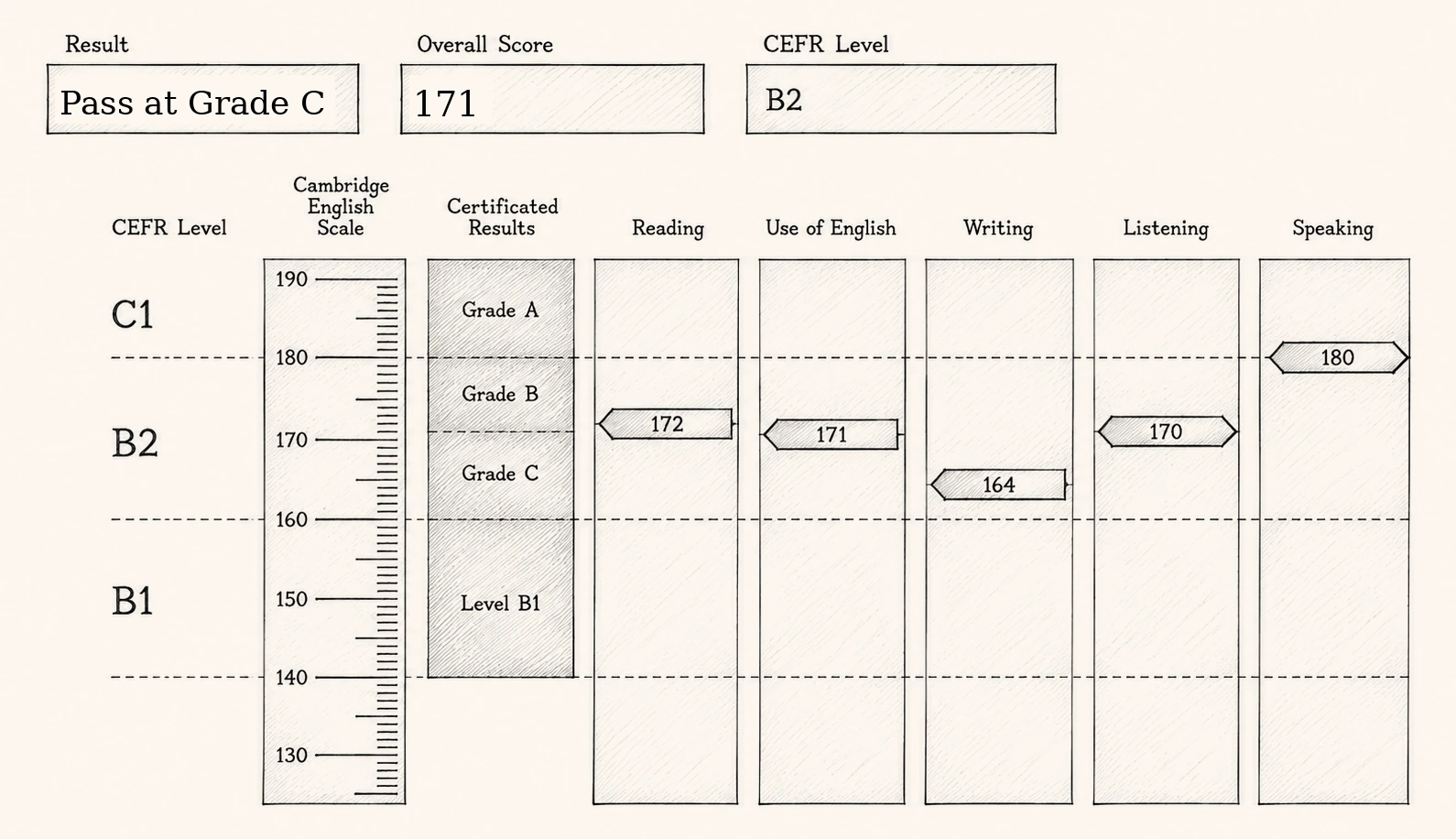
People naturally measure themselves according to their strongest skill. Someone reads specialist texts at C1 and therefore says they ‘have C1’, even though they speak at B1 and could not write a formal letter at B2.
Another person speaks fluently because they use the language at work every day, but their writing is effectively a phonetic transcription of speech.
A third — typically the most conscientious — consistently underestimates their level and spends years in coursebooks two levels below where they belong.
An examination measures the components separately — reading, listening, writing, speaking and control of language resources — and exposes the asymmetry precisely. This is not humiliation. It is calibration.
Calibration has practical value: once people know where their weakness lies, they can stop investing time in what they already do well.
The most common form of comfortable self-study is precisely the opposite: continuing to practise what already works because it works. The reader reads, the speaker speaks and the weaker skills wait quietly.
Preparation for a certificate disrupts this comfortable imbalance.
An Examination Forces Us to Do What Nobody Does Voluntarily
Writing, for example. Adult students postpone writing longer than any other skill because it is laborious and the easiest to avoid in ordinary contact with a language. It cannot be avoided in an examination.
The examination also requires things that learners often cannot make themselves do: speak continuously for a set period, structure an argument, summarise what they have heard, formulate an objection, defend an opinion and respond without lengthy preparation.
The formats used by major examinations are not arbitrary school exercises. They are carefully constructed samples of real situations: a formal letter, a complaint, a position statement, the presentation of an argument, or comprehension of a native speaker who is not speaking for a coursebook.
Preparing for a certificate is therefore one of the few forms of study that systematically covers weaknesses rather than strengths, because the format does not allow anything to be omitted.
That is not an unpleasant obstacle. It is information.
There is also a side effect: someone who completes good preparation for C1 suddenly knows how to do things they never planned to learn. Not for the sake of the examination. The examination was merely the pretext that made those things impossible to avoid.
Writing Is the Slow Laboratory of Language
Writing is slow. It exposes errors. It cannot be rescued by a smile, a gesture or a rapid change of subject.
Precisely for that reason, it carries so much. In writing, people see their language slowly enough to recognise what regularly slips past them in speech: recurring word order, the same safe patterns, vague vocabulary, missing articles and prepositions, or weak sentence structure.
Above all, they are not correcting a coursebook exercise. They are correcting their own thought.
An error in a sentence with which someone genuinely wanted to communicate something has a different weight from an error in an isolated exercise. It is not about a red pen. It is about a more precise version of one’s own voice.
Good certificate preparation should therefore not consist of an endless series of anonymous practice papers. It should involve the learner’s own texts, repeated returns to them and increasingly precise work with what the student can already say — but cannot yet say accurately enough.
A Test Is Not Merely Measurement
A practice test will not teach anyone a language by itself. But it can create a situation in which the student must genuinely retrieve knowledge rather than merely recognise it again on the page.
That is a fundamental difference.
Reading the correct pattern and saying ‘I know that’ is not the same as using it under time pressure in one’s own text or answer. Only then does it become clear what is genuinely active and what remains merely familiar in passive recognition.
Cognitive psychology uses the terms testing effect and retrieval practice for this mechanism: active retrieval supports long-term retention more effectively than repeated rereading of the same material.
This is why tests are useful not only at the end of preparation.
A practice format reveals what the learner can actually do without support. It shows whether vocabulary remains passive, whether a rule can be retrieved under time pressure, whether the student can organise a text and whether they can understand when they are unable to pause a recording after every sentence.
The score is not a measure of human worth. It is a measurement.
Precise measurement has a surprisingly powerful effect on adults. Someone who runs a company, manages a medical practice or carries responsibility for other people can derive exactly the same pleasure from a rising practice-test score as a child does from a top mark.
That is not trivial.
It is the need to see progress in black and white — a need that adults’ everyday work often fails to satisfy.
‘I Don’t Want to Learn for a Test. I Want to Know the Language.’
This objection is valid only when preparation is poorly conducted.
Bad preparation teaches the student to work around the format: to search for a trick or memorise a few templates used solely to gain a point.
Good preparation uses the format to place pressure on genuine usability.
The learner must understand a longer text, summarise an argument, write a position statement, respond to a speaker, formulate an idea under time constraints and make decisions without prepared sentences.
These are not examination artefacts.
They are a meeting. A telephone call. A professional discussion. A conflict. A presentation. Situations in which language must be not merely approximately functional, but precise and independent.
The examination is a safe rehearsal room for them.
A Completed Chapter
Adult language learning tends to be boundless.
It is never finished. There is always another text to read, another word to add, another error to correct and another skill to develop. This openness is real, but over the years it can erode motivation more thoroughly than failure.
A certificate creates a chapter with a beginning, a middle and an end.
B1 passed. B2 completed. C1 verified.
This does not mean the language is finished. It means that a defined body of work has been completed and independently measured.
That experience is rare in adult life. Most things we do have no clear ending: work continues, family life continues, obligations continue. A language examination is one of the few places in which, after a sustained period of concentrated work, a person can receive a precise answer:
I can do this now.
It has been documented.
And I can continue from here.
A Sober Postscript
A certificate is not a language.
It is possible to prepare for a test and miss the living language. Some holders of high-level certificates are afraid to make a simple practical telephone call in the foreign language. Paper ages, and a language that is not used ages with it; a certificate from 2015 says very little about proficiency in 2026.
For some learners, the examination format is also counterproductive. Test anxiety is real, and for some people the stress takes away more than the deadline provides.
Other finish lines may work better: a lecture delivered in the foreign language, a published text, a conversation one finally dares to conduct, a presentation at work or a journey managed independently.
A certificate is one possible form of a full stop. It is neither the only one nor a compulsory one.
It is a tool — but a tool that provides precisely what adult study most often lacks: structure, a date, measurement and the end of one chapter.
The Wrong Question
‘What use will the certificate be to me?’ assumes that the value lies in the paper.
It does not.
The value lies in what the journey towards it does to the learner: months of structured work across all skills, a date that cannot simply be moved, a format that does not permit weaknesses to be omitted, and a result that can be measured.
A certificate changes the architecture of the situation. It turns an undefined wish into a project, a feeling about one’s level into calibration, and endless learning into a completed chapter.
The piece of paper can then be placed in a drawer.
Its most important work was completed long before it was printed.