Your friend’s son has been singing English songs since nursery. The neighbour’s daughter goes to a club with a native speaker. Online, you read that the “language window is closing” and that whatever a child does not manage by the age of six, they will never catch up on.
And your child is in Year 2 and can barely say hello in English.
You have not missed anything irreparable.
This does not mean that early contact with English makes no sense. It only means that the age at which the first club begins is not a guarantee of future language level. What matters above all is what kind of contact with the language the child really has, whether they communicate something of their own in it and how subsequent teaching builds on this experience.
Let Us Not Confuse Acquisition and Teaching
A child in a bilingual family, in an English school or during a long-term stay abroad acquires English. The language is part of their everyday life. They need to solve something with it, answer someone, ask for something, explain something. They hear it many times a day in different situations and from different people.
One or two lessons a week are something else.
They can be a pleasant first encounter with the language. They can give the child rhythm, sound, a few songs, joy in new words or the courage to repeat after another person. But they should not be sold as a small version of bilingual childhood.
A native speaker alone does not turn a club into immersion. Immersion is not determined by the nationality of the teacher, but by volume, regularity and a real need to use the language.
Patricia Kuhl’s well-known experiment showed that American infants learned to distinguish new phonetic contrasts through live contact with a speaker of Mandarin, while an audio-equivalent recording or video did not have the same effect. The authors call this principle social gating: language learning is opened by social contact, not by mere exposure to sound. This does not mean that every children’s course without immersion will fail. But it shows an important principle: mere exposure is not the same as social language learning, and age itself is not the mechanism that triggers learning.
A Club Can Be Good. But It Does Not Have to Be a Language Foundation.
English songs, games, colours, animals or simple phrases are not a problem. Children naturally learn through ready-made chunks too: I’m fine, Can I have…?, I don’t know. Such sentences can be a beginning.
The problem arises when teaching stops there.
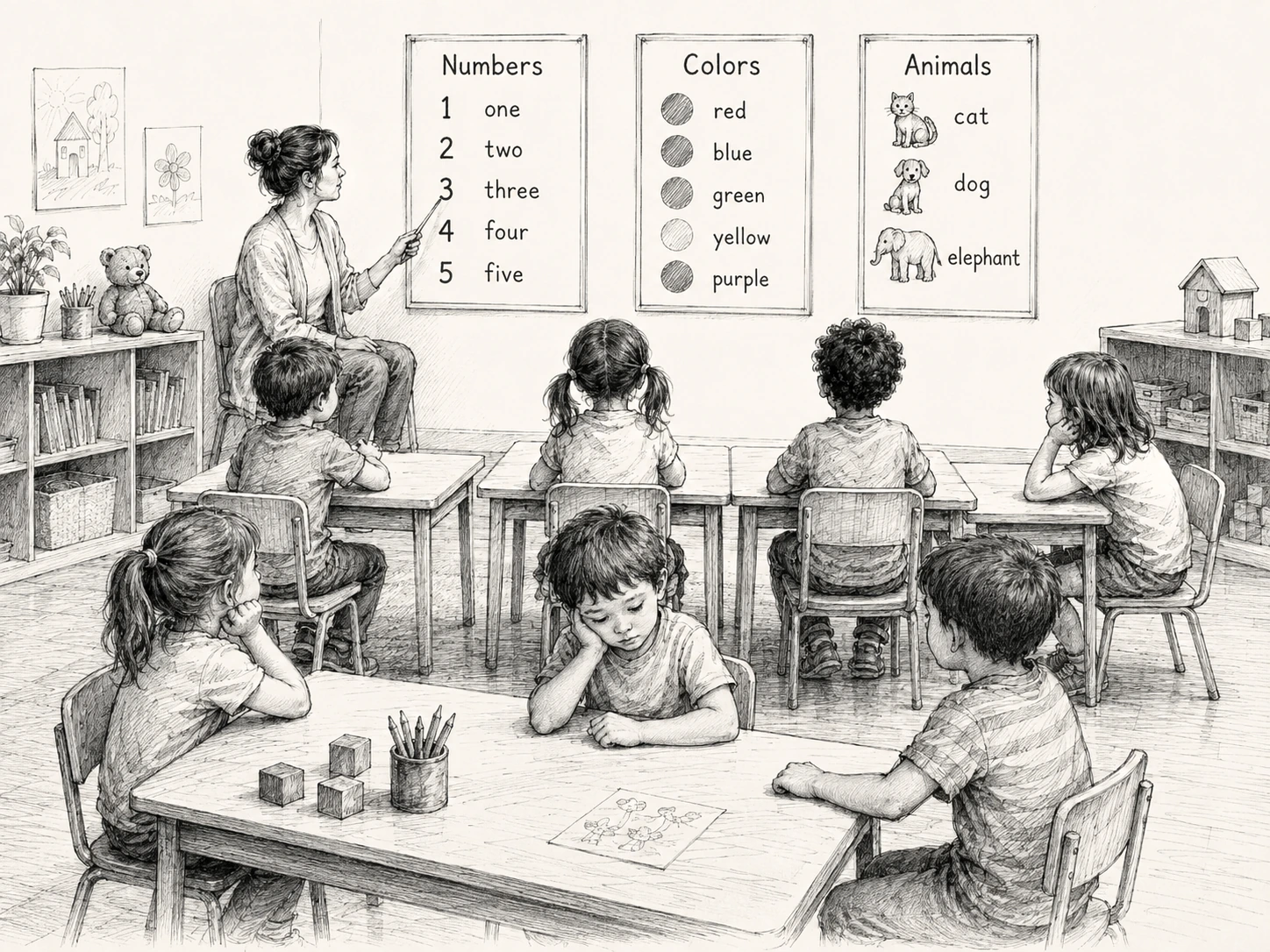
In practice, I regularly meet children who, after several years of English, reliably recognise a picture and list vocabulary items, but cannot ask for something in English, ask a question, respond to not understanding or retell their own experience.
This is not a lack of colourful materials. It is that they have not yet experienced the language as a tool for action.
A child may then acquire the implicit idea that English means recognising the right picture, repeating the right answer and not being corrected. Later this idea has to be rebuilt: language is not a naming test. It is a way to say something to another person, find something out from them, make an agreement, disagree, tell a story and be understood.
Year 3 Is Not Late. Nor Is It a Magic Boundary.
I am not saying that a child must wait with English until precisely Year 3. No such biological boundary exists.
I am saying that at the moment when a child reads, writes and can concentrate on a system, a different way of working with language opens up for them. They no longer hear only sound. They can return to it in text, notice repetition, compare structures, write their own sentences and gradually understand how meaning is built.
Literacy is not an obstacle to early contact with a foreign language. But it is a very good supporting structure for systematic learning.
A child who already understands that letters carry sound and that a sentence has structure is not building the second language on sand. They can begin to observe differences: why an English sentence is put together differently, what happens to the verb, why the same word is sometimes read differently, what changes when we swap the order of words.
Some skills connected with reading — especially phonological awareness and decoding — do indeed transfer partly between languages. This does not mean that Czech and English function in the same way. It means that the child already has tools for thinking about language material.
What Research Shows About Starting Age
Research into instructed foreign-language teaching does not give a simple answer of “the earlier, the better”.
A meta-analysis by Becky H. Huang, which included 42 studies of formal foreign-language teaching, did not find a clear general advantage for younger beginners. In a large proportion of the studies, older beginners were similarly successful or progressed faster; limited advantages of an early start appeared mainly in the area of sound perception and pronunciation.
Nor do more recent longitudinal studies from Germany provide a simple counter-myth that “later is always better”. In one study, earlier beginners had an advantage in Year 5, while later beginners overtook them in Year 7. In another follow-up, earlier beginners were higher in Years 5 and 9, later beginners in Year 7. The results are non-linear and depend on continuity of teaching, the amount of contact and the characteristics of the specific pupils.
A large German study of almost twenty thousand Year 9 pupils compared children who began English in Years 1, 3 and 5. Differences in reading and listening comprehension were only small. The authors also emphasise the importance of continuity between primary and lower secondary schooling: an earlier start cannot bring the expected effect if subsequent teaching cannot build on it.
This is good news for parents. A child’s outcome cannot be predicted according to whether they began at four, six or eight years old.
The explanation for why older children often progress more quickly is not mysterious. An older child has longer guided attention, more effective memory strategies and above all the ability to work explicitly with a rule. The concern that grammar is “too abstract” is not supported by the data: a child who manages Year 3 mathematics — fractions, word problems, unit conversions — operates with abstract rules every day.
Basic grammatical relationships in English therefore need not be inaccessiblely abstract for a school-age child. The problem is usually not that the child is “not yet ready for grammar”, but how the system is shown to them.
I know a child for whom every form of teaching had failed for several years, including one-to-one lessons with a native speaker. At the age of eight, instead of songs, the child received systematic grammar explanation using a coursebook designed for language schools, extensive listening through films and regular conversation with peers who genuinely communicate in English.
Within two years, the child reached a level that the previous years of teaching had not suggested at all. The decisive factor was not a sudden discovery of talent, but timing aligned with cognitive maturity — and the combination of system with a real communicative need.
When an Early Start Really Makes Sense
It makes sense when the language is alive.
In a bilingual family. During a long-term stay abroad. In a school where English is used during the day for real communication, not only in one lesson. There it is not an extra club. It is another language of the child’s life.
A club that the child genuinely enjoys also makes sense — provided the parent does not expect that by paying for it they are buying a future C1.
A child may attend English in nursery because they like songs, movement, the teacher or the group. That is a sufficient reason. But there is no need to turn it into a race or an investment against future loss.
The risk is not early contact with English. The risk is the pressure attached to it: the child is supposed to be ahead, know more than others, confirm that the parents decided correctly.
A language learned only so that an invisible window is not missed can very quickly become another performance obligation.
What Matters Is the Method, Not the Date
A child does not need to start English as early as possible.
They need to start at a time and in a way in which the language can become a means of communication — not another set of worksheets, pictures and correct answers.
Good English does not arise from the date on an application form for a club. It arises from high-quality, long-term and continuous contact with the language. From a system. From work that makes sense to the child. And gradually also from people towards whom their sentences can go.
A seven-year-old child who does not speak English fluently has therefore not missed anything irreparable.
It is not too late. It is time to start well.