‘Children learn languages better’ is one of the most widespread claims about learning of any kind. It is repeated so confidently that few people stop to examine it.
Like most statements that seem self-evident, it is only partly true.
Later in life, you do not learn a language as you did at fifteen. That is not a euphemism for ‘worse’. It means that you cannot rely on the same mechanisms: rapid absorption, unlimited time and carefree repetition. On the other hand, you no longer enter a language without a map.
Children have certain advantages. Adults have others. The decisive question is not who is ‘naturally better’, but what kind of work corresponds to their possibilities.
Where the Myth Is Right
Children have an advantage above all in long-term, natural acquisition. When a language is part of their everyday life, they absorb it without having to formulate rules consciously. This is particularly true of the sound system, the rhythm of speech and some forms of implicit learning — the capacity to detect regularities even when no one has explained them.
But children usually do not have an advantage because they possess a ‘better brain for languages’. They often have an advantage because they have different conditions.
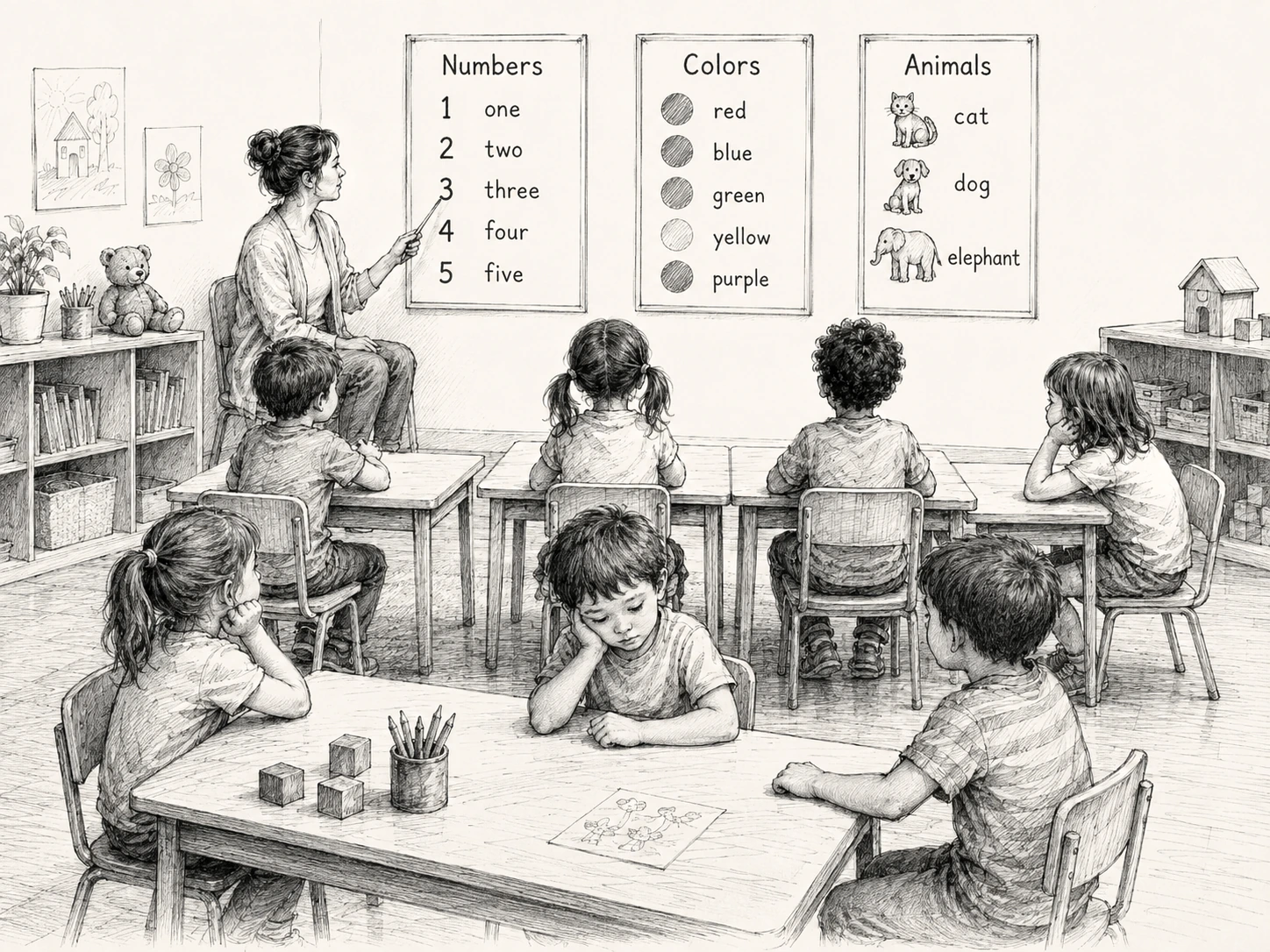
A child in a bilingual family, an international school or an immersion environment hears the language for many hours a day. They need to respond through it, obtain something, answer someone and function within a group. Alongside language learning, an adult student is working, running a household, managing a team, caring for a family or carrying professional responsibility.
When we compare their results after a year, we are often not comparing abilities. We are comparing timetables.
What Happens When the Conditions Are Comparable
When children and adults receive similar material, a similar amount of time and similarly structured teaching, the picture ceases to be one-sided.
Older children and adults often progress more quickly in the initial stages. In an experimental study involving an artificial language, adults remembered more words, formed sentences more accurately and distinguished grammatical from ungrammatical formulations more successfully. Explicit instruction — work with rules, explanation and feedback — improved performance in both groups.
A similar pattern appeared in the classic longitudinal study by Snow and Hoefnagel-Höhle: during the first months of naturalistic Dutch learning, older children and adults progressed faster than younger children. The long-term outcome was more complex and depended on other conditions, but the assumption that younger learners always progress faster was not supported.
This does not mean that an adult will always ‘beat’ a child. It means that adults have a different set of tools available: analytical thinking, the ability to work with rules, compare systems, recognise an error and correct it deliberately.
A child may absorb a language over a long period. An adult can construct it consciously.
A Language Is Not Brain Training
Language learning later in life is sometimes marketed as a way to prevent ageing or as a substitute for cognitive training. It is better to be cautious here.
One randomised study involving 76 people aged 65 to 75 found that sixteen weeks of app-based Spanish lessons led to improvements in executive function comparable to those achieved by a group undertaking targeted cognitive training. The language group also rated the programme as more enjoyable.
Other intervention studies, however, have not found the same effect and explicitly note that the evidence available so far is limited and inconsistent.
There is therefore no need to sell a language as therapy or as guaranteed ‘brain training’. It is an intellectually demanding activity that combines memory, attention, comprehension, decision-making, social contact and work with a new system. That is enough in itself.
What Age Really Takes Away
A complete picture must also include what age genuinely takes away.
Later in life, it may be harder to perceive rapidly sound contrasts that do not exist in the first language. Pronunciation without a perceptible accent becomes less likely, particularly when intensive contact with the language begins only in adulthood.
Retrieving particular words under pressure may also become slower. A person knows exactly what they want to say and has the meaning clearly in mind — but the word does not arrive for a moment. This ‘tip-of-the-tongue’ state becomes more frequent in healthy ageing, although in connected speech it need not create a serious limitation.
And then there is time. Not biological time, but actual time.
An adult student has less room for aimless immersion. They cannot afford to spend years ‘listening to things’ and hoping that the system will eventually settle by itself. They need to select what matters, return to it and prevent the work from dissolving into the demands of the week.
These are not barriers. They are parameters.
And parameters can be addressed systematically.
What Age Gives
Adulthood does not automatically guarantee discipline, metacognition or an ability to plan. Some students still learn haphazardly at fifty, overestimate what they know and underestimate the need to return to material.
The difference is that an older student has these possibilities available.
They can learn more consciously. They can monitor what works, plan the next step, recognise the gap between ‘I understand this’ and ‘I can use this actively’, and adjust their own strategy. This ability to monitor and regulate one’s learning — metacognition — is one of the essential components of effective study.
A mature learner can distinguish the important from the incidental. They do not need to know everything. They can define precisely what they need from the language: conducting professional negotiations, reading medical articles, giving a presentation, understanding films, travelling independently, writing precise emails or preparing for a certificate examination.
This selection is not a limitation. It is an advantage.
A child may learn the word negotiation. A manager already knows what negotiation is. They need to attach precise language to existing experience. A doctor does not first need to understand the principle of diagnosis; she needs to be able to name it, explain it and discuss it in another language.
For an adult, a new word need not be an isolated sound. It can connect to a dense network of experience, concepts and real situations.
Forgetting Is Not Proof That It Cannot Be Done
Many adult learners do not give up because they have learnt nothing. They give up because they expect a word, once learnt, to remain in memory for ever.
It does not have to.
A forgotten word is not a lost word. It is a word to which the brain still needs to return.
Vocabulary learning does not work like filling a container. It works through repeatedly creating and renewing a route. A person sees something, understands it, retrieves it, forgets part of the detail, retrieves it again, uses it in a sentence and encounters it in another context. Only then does the word begin to settle properly.
Research on foreign-language vocabulary repeatedly shows the advantage of active retrieval over simply rereading and repeating material. For productive vocabulary, it is particularly effective when the learner must first produce the word or construction from memory and only then receives feedback.
An older student need not have a ‘better memory’. But they can have a more realistic relationship with memory.
They do not treat it as a container that ought never to leak. They treat it as a process that must be maintained.
Discipline Does Not Mean Having More Time
Adult students do not generally have more time than children. They often have less.
They can, however, understand the value of regularity more clearly. Thirty minutes three times a week, each session with a clear purpose, will outperform a several-hour weekend burst followed by two weeks without contact with the language.
Not because every older person is naturally disciplined, but because an adult can see the relationship between a small repeated step and a long-term result.
A child often needs someone else to establish the rhythm. An adult can gradually create it for themselves.
This is fundamental in language learning. It is not a matter of mobilising willpower once. It is a matter of creating a system that survives a business trip, a deadline, a child’s illness and periods when the learner does not feel like working.
Age Does Not Change the Ability. It Changes the Method.
‘Am I too old to learn a language?’ is the wrong question.
Age does not determine whether you can learn a language. It determines some of the conditions under which you will learn it. Pronunciation may require more conscious work. A word may not come to mind as quickly. Time will be scarcer.
On the other hand, you no longer enter the language without content.
You have experience, professional thinking, the ability to select, compare, plan, return and decide what is worth your time. You can learn through a system rather than at random. You can develop a relationship with error that is not humiliating but practical. You can understand that forgetting is not failure — and that accuracy is not built once and for all, but through repeated return.
A child learns through immersion and through time, of which they have a relative abundance.
An adult can learn through selection, system and regularity.
Systematic teaching does not fight this change. It builds on it.