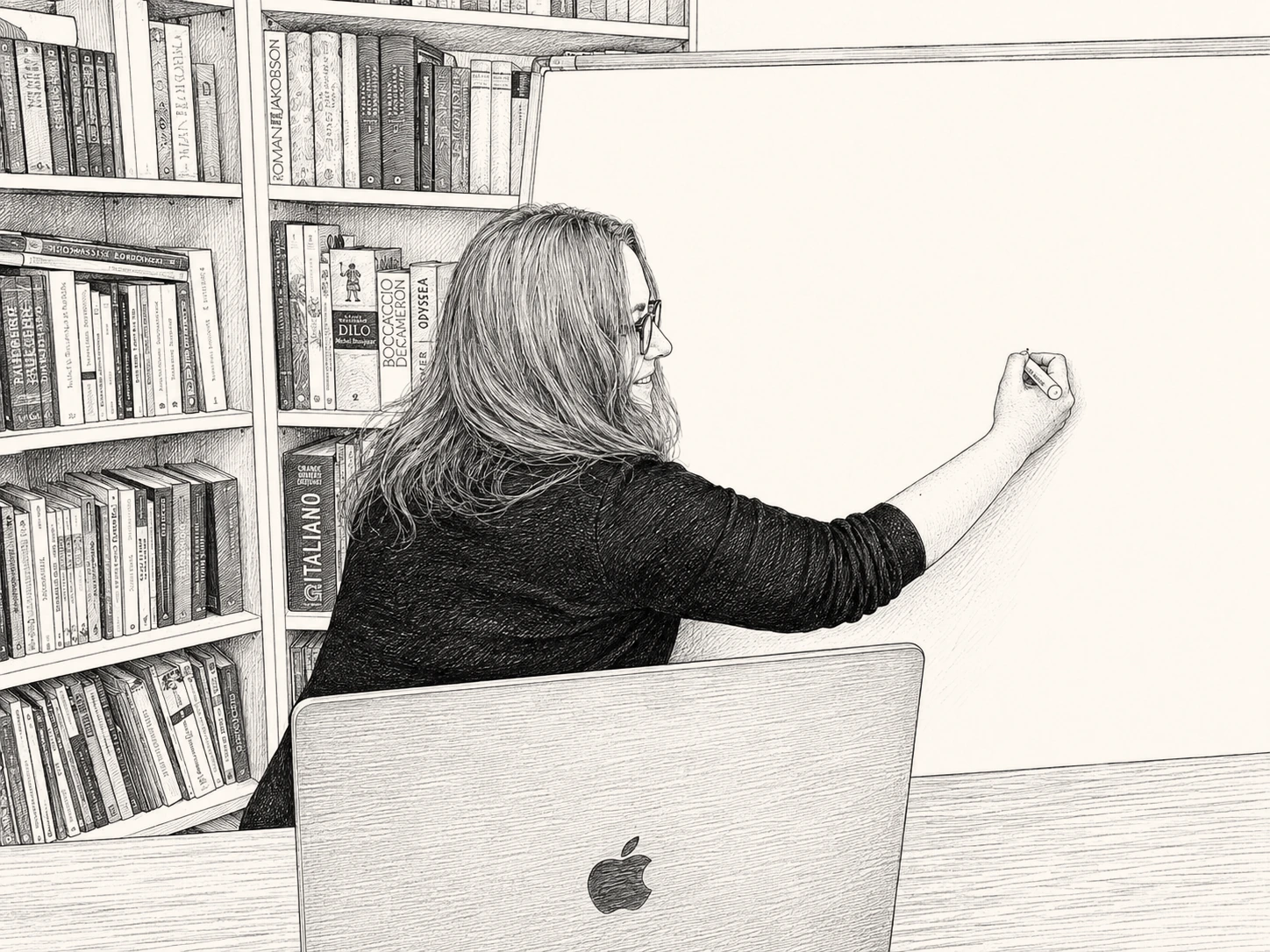
I teach online, and beside my desk, on an artist’s easel, stands a plain white ceramic board. When we come to grammar, I move it directly in front of the camera.
That movement is part of the method: a signal that the mode is changing. Now we are going to build.
Students sometimes ask about it: why use a marker and cloth when there are shared documents, interactive presentations and tablets with styluses? Yet I do not set online teaching against technology. I use the whiteboard alongside digital tools, not instead of them, for the kind of work it allows us to do more precisely.
At first glance, a whiteboard in an online lesson may look like an anachronism, somewhere between nostalgia and habit.
It is not a habit. It is a methodological decision — and perhaps the most important one I have made for my online teaching.
A Rule Must Be Born Before the Student's Eyes
When I explain a grammatical structure, I do not have it prepared on a slide. I write it on the board there and then, in front of the student, step by step.
The sentence takes shape. Each ending has its own colour. Verb positions are placed in boxes. A prefix moves along an arrow. A pattern emerges from the examples, a rule from the pattern and new sentences from the rule.
The student therefore does not see a finished rule inside a box. They see how the rule comes into being — and how it then begins to generate language in its own right.
That is a fundamental difference.
A box in a textbook is the product of thought. The whiteboard is thought itself: all its stages, hesitations, false starts and corrections.
We do not learn a language from finished results. We learn it from the process. One day, the student will have to carry out that same process alone, without the board and without me.
A shared document can, of course, be just as dynamic as a whiteboard. It can be written on, crossed out, rearranged and colour-coded. In practice, however, it is often used as a place for finished text: a sentence appears, a correction replaces it and the path that led there disappears.
On the whiteboard, I leave that path visible.
On a screen, letters can sometimes appear fully formed from a blank page, like traces emerging on the Marauder’s Map in Harry Potter. It is elegant — and it is magic.
Magic conceals how things are done.
Teaching should do precisely the opposite.
The Hand Is the Medium
The difference is not merely aesthetic.
Research into instructional videos suggests that a drawing which develops gradually may help a student more than the same diagram presented all at once in its finished form. In the psychology of learning, this is sometimes described as the dynamic drawing effect: the student observes not only the completed image, but the emergence of a structure over time.
The movement of the hand directs attention. The eye naturally follows the place where a line or word is appearing; there is no need to keep saying, ‘Look here.’
The pace of writing also regulates the flow of information. A hand is slower than a slide — and often exactly as slow as understanding needs to be. A finished image presents everything at once. A whiteboard allows the structure to be assembled in the order in which the student needs to understand it.
The point is not that a marker is inherently better than a tablet or digital pen. What matters is whether the student is watching a finished result or a thought taking shape. They are watching the writing, not merely what has been written.
On the whiteboard, language appears as what it is: a system in motion, not a collection of finished forms.
Each Medium Has Its Own Work
This does not mean that I reject digital tools. On the contrary, I use them constantly.
I put vocabulary in the chat or directly into Quizlet. I use shared documents when a text needs to remain available, be revised and returned to later. Recordings, links, online tests and digital materials all have a precise place in online teaching.
That is exactly why the whiteboard has a place as well.
A vocabulary item is an entry: it belongs in a list that can be searched, reviewed, exported and tested. Grammar, sentence structure and the correction of recurring errors belong on a surface where they can be taken apart, connected, moved, crossed out and assembled again.
This is not a contest between analogue and digital. It is a division of labour. A list when the work concerns items. A surface when it concerns relationships.
The Whiteboard Holds the Lesson Together
There is another, less obvious function.
What I write on the board remains there until we move on to a different topic. The rule stays in view while the student practises. Their eyes return to it. I point to it. Over the course of the lesson, the board fills up and becomes a map of the ground we have covered together.
A presentation usually cannot do this. A slide disappears with a click, and the entire route disappears with it. The whiteboard, by contrast, builds the landscape of the lesson — and a landscape can be navigated, revisited and understood through its connections.
I photograph the board as we go and send all the images to the student at the end. They do not leave with a file that was displayed to them, but with a record of work we did together: the sentences they formed, the mistakes we corrected and the rule we arrived at together.
And I admit a side effect as well: the board makes me stand up, turn round, point and write with an actual hand. It gives the lesson a physical reality.
It is not a video call about a language. It is teaching transmitted through a camera.
A System Cannot Be Shown as a Finished Product
On my website, I write that language is a system. The whiteboard follows directly from that statement.
A system cannot be handed over as a finished image. It can only be demonstrated in operation: how a small number of rules produce many sentences, how structures fit together, where regularity breaks down and why.
All of this must happen before the student’s eyes, step by step, by hand.
A whiteboard on an easel is the fastest tool for slowing down that I know.
And in language learning, slowing down is often exactly what learning requires.
Technology should not be chosen according to how new it is. It should be chosen according to what it does to thought.
Hence the whiteboard.
Not out of nostalgia — for precision.