The question ‘isn’t online teaching merely a substitute for the real thing?’ assumes that real teaching takes place in a room.
But the real thing is not the room. It is the conversation. And today, much of that conversation takes place through a screen.
I have been teaching languages since 1998. Until 2020, I combined face-to-face and online teaching; since 2020, I have taught exclusively online. I know both forms from the inside, and I have known them for a long time. For me, the comparison does not end in a draw: for regular one-to-one teaching, with both adults and children, the online format is more precise and more effective in several important respects.
Not in every situation. Not for everyone.
But where the aim is long-term, individual work with a language, online teaching offers advantages that face-to-face teaching simply does not have.
The Lesson That Actually Takes Place
The most mundane difference often has the greatest impact: online lessons are cancelled less frequently.
A face-to-face lesson depends on a fragile chain of circumstances: transport, weather, a sick child, a meeting that runs over, a delayed train, an after-school activity at the other end of town. Any link in that chain can cause the lesson to be cancelled.
An online lesson requires only one thing: logging in.
That may sound prosaic. Pedagogically, however, it is fundamental. In language learning, continuity is one of the conditions without which even a good method cannot work. Every cancelled lesson is more than sixty lost minutes. It is a broken rhythm that the student must then recover.
The online format often sustains that rhythm more reliably by design.
Then there is the time that is not spent travelling. A face-to-face lesson often costs an adult student two hours of their life: the lesson itself and the journey there and back. An online lesson takes one hour.
For children, this matters even more. Parents are spared the logistics, waiting in the car and rushing between school and activities. The child does not arrive at the lesson out of breath after changing or after travelling across the city, but joins from a familiar setting, with a better chance of still having the capacity to think.
Teaching that takes place regularly is more valuable than an ideal format that is constantly being cancelled.
Materials: Everything in One Place, Available Immediately
This difference receives less attention than it deserves.
In face-to-face teaching, materials always involve compromise: printing, photocopying, carrying, filing, searching and losing. Correcting a text means pen marks in an exercise book, a note on a piece of paper and, often, a week’s wait before the student receives an explanation.
Online, both teacher and student have everything in front of them at the same time.
A text is corrected in a shared document before the student’s eyes. They see their sentence being rebuilt step by step. They can ask a question at the moment the correction is being made — not over a finished version a week later.
Vocabulary and phrases that emerge during the lesson go into the chat or directly into a revision app. The student does not have to lose the thread by writing down everything that is being said. After the lesson, they have an exact record to which they can return.
A text, a recording, an image, an exercise, a link, a corrected email, a vocabulary list: one click, one place, no paper.
The result is not merely convenience. It is structure. The materials from the lessons form a coherent, searchable whole instead of being scattered across exercise books, binders and folders.
The Screen Is Not the Problem. What Happens on It Is.
The most common objection is: ‘Children already spend all their time looking at screens — do lessons have to be on one as well?’
I understand the concern. A screen is not, in itself, a neutral environment. It can fragment attention, encourage constant switching and create a dependence on rapid stimulation.
But a one-to-one online lesson is not simply more passive screen time.
It is concentrated work within a narrow channel: a voice, a face, a text and a shared task. The child is not faced with a stream of videos or a game that rewards every click. There is a specific person who responds, waits for an answer, corrects and builds on what the child says.
That distinction is fundamental. The same medium can carry passive consumption or highly precise work. The screen itself does not decide. What matters is the form of attention we create through it.
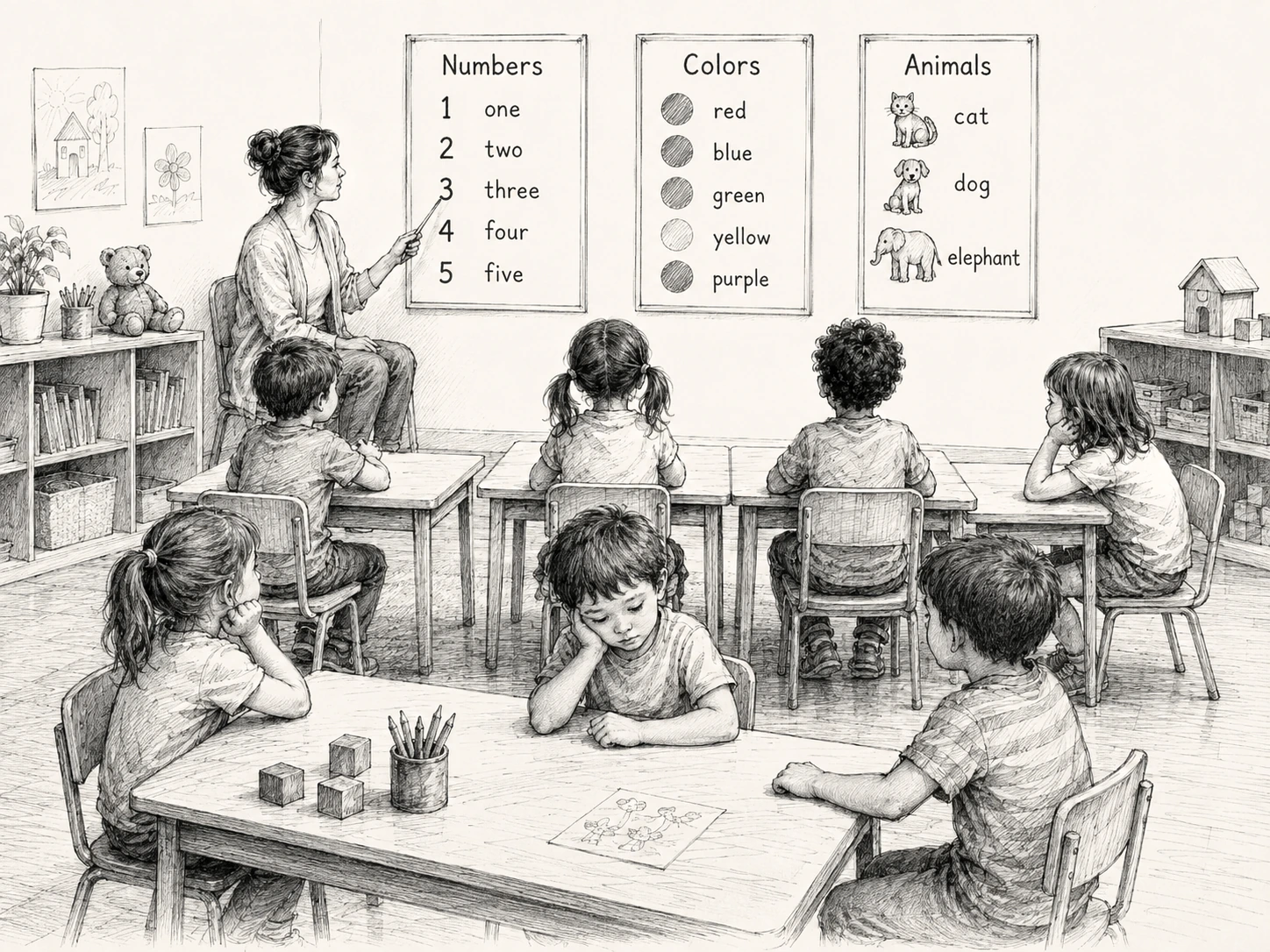
For many children, the online environment is also calmer than a classroom or a busy afternoon spent moving between activities. They sit in a familiar space, often wearing headphones, without strangers, waiting rooms or journeys. Their attention does not have to be divided between the room, their surroundings and a group. It can remain between the teacher, the student and the language.
This does not apply to every child. Some need physical presence, more movement or a parent nearby.
Practising the Situation in Which the Language Will Be Used
This argument appears surprisingly rarely in discussions of online teaching.
An adult student will often use a foreign language through a screen: in meetings, video calls, job interviews, consultations and telephone calls, or when communicating with an international head office or a client.
Speaking a foreign language to a camera, sometimes with a slight delay, without the full range of body language and without being able to rely on the other person’s physical presence, is a skill in its own right.
A face-to-face lesson does not practise it.
An online lesson does — all the time.
A lesson at a table prepares the student primarily for a conversation at a table. An online lesson prepares them for a video interview, a remote professional consultation, a meeting with colleagues in Munich or London, a telephone call with a client or a presentation delivered through a screen.
It is not a substitute situation that is being practised.
It is the real one.
Online Does Not Mean Less Real
One of the greatest mistakes in online teaching occurs when the teacher merely attempts to imitate a face-to-face lesson.
The online environment is not a classroom transferred onto a screen. It has its own tools: shared texts, chat, recordings, immediate access to materials, the ability to return to previous work, collaborative writing in real time and rapid movement between text, sound and image.
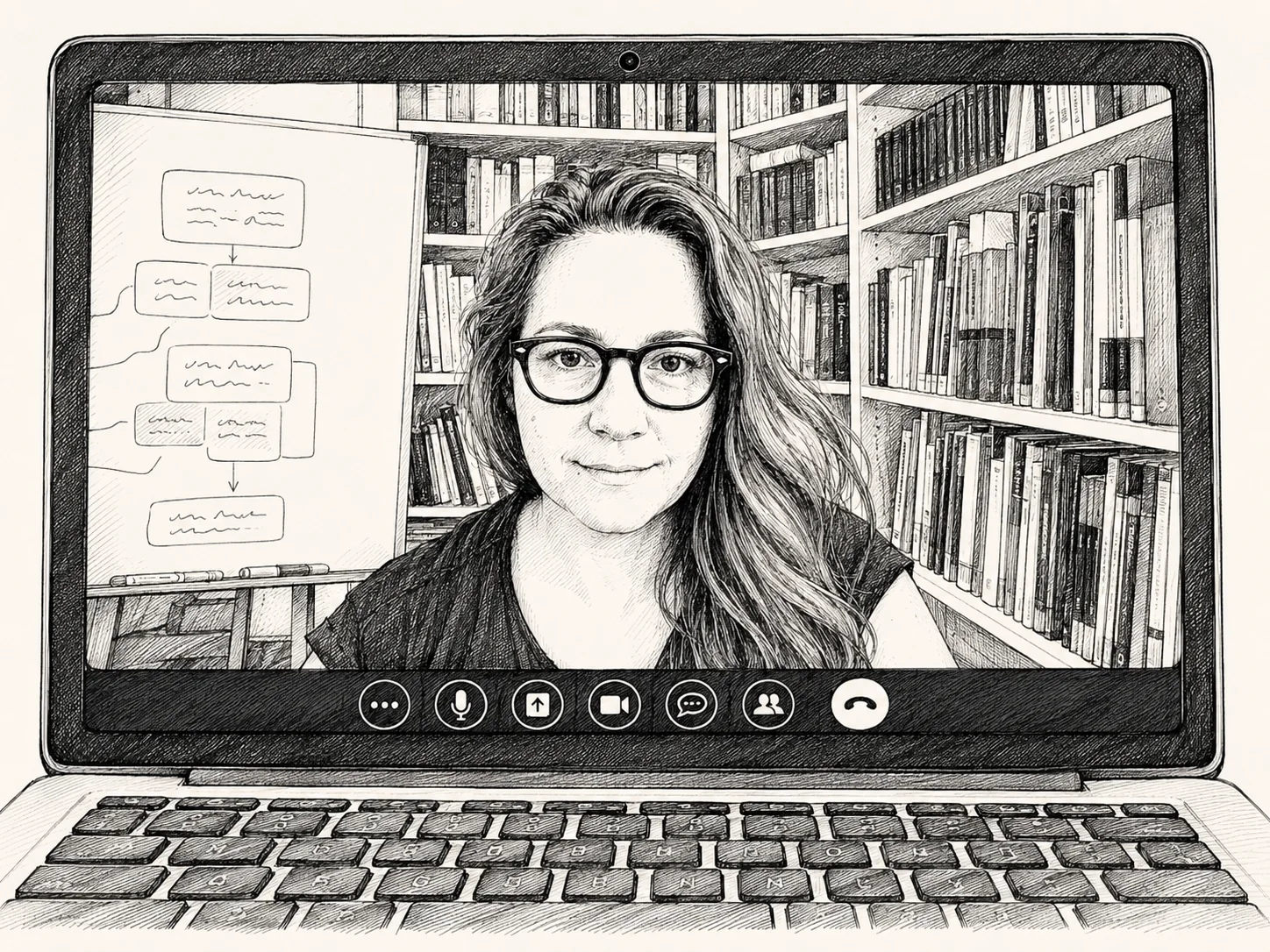
It can also include a real whiteboard within the camera frame, on which a rule takes shape by hand and in real time.
The aim is not for online teaching to pretend to be a classroom.
The aim is to design the teaching so that it makes full use of precisely what the screen allows — and then adds what the screen itself cannot provide: a live response, a real conversation, precise correction, patient slowing down and methodical guidance.
A good online lesson is not a video call about a language. It is teaching transmitted through a camera.
What Online Teaching Requires
Honesty also requires acknowledging the conditions.
Online teaching needs a stable connection, headphones and a quiet environment. Not technological miracles, but reliable basics.
With younger children, it initially requires a parent nearby until a working routine has been established. For some students, the space in which the lesson takes place must be defined more carefully so that it is not full of distractions.
Above all, it requires a teacher who does not treat online teaching as an emergency copy of a face-to-face lesson.
When an online lesson is poorly designed, it can indeed be tiring, fragmented and superficial. When it is designed well, it can be more precise than a face-to-face meeting: less unnecessary clutter, less travel, fewer lost materials, a clearer record of the work and greater continuity.
Online teaching is not an inferior form. It is a different architecture of the learning situation.
The Best Form of Teaching
Teaching did not automatically become worse when it moved onto screens.
It can become more precise, more efficient and free of unnecessary burdens: commuting, paper, lost materials, distractions and cancelled lessons.
The core remains: two people, a language between them and a lesson that actually takes place.
Ultimately, that is the entire criterion.
The best form of teaching is not the one that looks the most traditional.
It is the one that takes place regularly, sustains attention, enables precise work and prepares the student for the environment in which the language will actually live.