Translation into a foreign language is not a substitute for conversation. It is a targeted tool for those moments when a student needs to stop relying on ways around the gaps in their knowledge and start closing them.
When I teach speaking, I teach students something essential for real life: when they cannot find the exact word, they must not fall silent. They should use what they already know.
Do not know the word screwdriver? Say the tool you use to turn a screw. Do not know how to say předplatné — ‘subscription’ — in the target language? Describe it. Missing a verb? Choose a different construction.
This is not an emergency measure. It is a compensatory strategy: the ability to keep communication going even when the language is not yet complete.
Without it, a person speaking a foreign language can easily stop in the middle of a sentence and begin frantically searching for the Czech word they want to convert. With it, they can keep speaking.
But compensation has another side. What I skilfully work around, I still do not know. And if I work around the same gap for five years, my language will not develop in that area.
A person can speak fluently and confidently for years while remaining within the safe circle of the same constructions. They can describe a problem but cannot express its cause precisely. They can tell a story but cannot distinguish a hypothesis from a certainty. They can make themselves understood while continuing to avoid past tenses, subordinate clauses, the conditional or more formal argumentation.
That is not a failing of conversation. It is one of its natural characteristics: the priority is successful communication, not completeness.
This is why, alongside fluency, I also train accuracy.
Fluency means speaking despite gaps, responding, improvising and maintaining contact with the other person. Accuracy means arriving exactly where the sentence is meant to go, even when a simpler route is not available.
For this, I use translation into the foreign language.
Why Translation Acquired a Bad Reputation
Translation did not acquire a poor reputation in language teaching by accident.
For a long time, it was associated with a form of teaching far removed from living language: the grammar–translation method, tables, exceptions, isolated sentences and the idea that a language is primarily a set of rules that can be converted from one system into another.
For Latin or Ancient Greek, this had its own logic. The aim was not to order a coffee at a railway station, but to read a text, analyse a sentence and understand classical literature.
For modern languages, however, this model was insufficient. A student could know the forms and be able to translate a sentence into Czech, yet still be unable to act through the language.
The response was understandable: teaching turned towards speaking, listening, situational work and direct contact with the target language. The first language became suspect in the classroom, and translation became a symbol of everything the newer methods wished to overcome.
But the pendulum swung too far.
A justified criticism of translation used badly became a prohibition on translation itself. It was as though the problem were not the mechanical conversion of isolated sentences, but the very possibility of consciously comparing two language systems.
The contemporary injunction to ‘learn like a child’ is the latest form of the same movement. It sounds natural, but it is misleading for an adult learner. An adult is not a blank slate. They already possess one language system. They have concepts, experience, the ability to compare and analyse, and the capacity to ask why a sentence works in Czech while its literal equivalent does not work in English, German or Spanish.
Ignoring this equipment is not modern. It is a loss.
This is not a return to the grammar–translation method. It is the rehabilitation of translation as a precise, controlled and carefully dosed tool.
Not instead of communication. Alongside it.
Difficulty Is Not the Same as Bad Teaching
There is a difference between a poorly designed exercise and one that is genuinely demanding.
A poorly designed exercise merely confuses the student. They do not know what is expected, cannot see how it relates to the objective and, after ten minutes, are simply more tired.
A well-designed demanding exercise slows the student down but shows them exactly what they are working on.
The psychologists Robert and Elizabeth Bjork use the term desirable difficulties for this principle. Some learning conditions may make immediate performance worse while supporting longer-term retention and transfer.
Difficulty, then, is not in itself evidence of quality. It must be proportionate, meaningful and connected to feedback.
Translation can be precisely this kind of difficulty.
The student stops at a single sentence. They discover that the Czech construction cannot be transferred word for word. They must choose between two tenses. They must decide which article English requires, which case German requires or which verb form Spanish requires. Then they must understand why.
This is not pleasant in the sense of immediate ease. But it is highly precise.
An Adult Learner Already Has a Language
The advice to ‘learn like a child’ sounds attractive, but for an adult learner it is often misleading.
A child acquires their first language in a situation in which they need it throughout the day: they want something, fail to understand something, receive an answer, repeat, imitate, experiment and continually adjust their speech in response to the people around them.
An adult learns a foreign language differently. They already have a fully developed first language, decades of experience, the ability to analyse and compare, the capacity to name a problem and the means to construct a system consciously.
This is not an obstacle to be suppressed. It is a resource.
It simply has to be used well.
The first language must not govern every sentence. It must not become a crutch beyond which the student cannot progress. But neither does it make sense to pretend that it does not exist in the mind.
Contemporary approaches to multilingualism discuss the pedagogical use of the learner’s entire linguistic repertoire. This does not mean switching freely between languages without a purpose. It means consciously using what the student already knows in order to understand more clearly where systems coincide, diverge or create misleading similarities.
This is precisely where translation has a place.
Translation Does Not Compare Words. It Reveals What the Sentence Does.
Translation is often understood as a comparison between two dictionaries: a Czech word set against an English, German or Spanish word.
In reality, it is far more interesting. It forces the student to discover how a sentence is organised as a message.
What is this sentence about? What does the listener already know? What is new? Where does the emphasis lie? What is background and what is the actual message? What must be preserved if the translated sentence is genuinely to say the same thing?
In the Czech linguistic tradition, this level is described as aktuální členění větné — in English, functional sentence perspective: theme, rheme and the communicative core of the utterance. Contemporary linguistics refers more broadly to information structure.
Every language must in some way distribute given and new information, theme and rheme, emphasis, contrast, cause, consequence, condition or reservation. But languages do not use the same means to do so.
Because of its richer inflection, Czech has relatively free word order. It can therefore alter the perspective of a sentence subtly through the order of its words:
Včera mi volal Petr. — Yesterday, Peter called me.
Petr mi volal včera. — Peter called me yesterday.
Mně včera volal Petr. — It was me that Peter called yesterday.
English works with a more fixed basic word order. It therefore expresses shifts in perspective more often through stress, articles, auxiliary verbs, the passive, cleft constructions or a complete restructuring of the sentence:
Peter called me yesterday. It was Peter who called me yesterday. Peter called me, not Anna.
The point is not that Czech ‘gets in the way’ and English is more correct. Both languages solve the same communicative task by different means.
Translation makes precisely this visible. The student stops searching for a single Czech word that ought to have an English equivalent. They begin looking for a structure in the target language that can carry the same relationship of meaning.
An Error Is Often Not Random. It Has a First Language.
Many recurring errors do not arise because the student ‘does not know the grammar’. They arise because the student intuitively uses a procedure that is logical in Czech but does not work in the same way in the target language.
In Czech, we say:
Bydlím tu pět let. — literally, ‘I live here for five years.’
To express the same relationship between past and present, English will normally use:
I have lived here for five years.
I have been living here for five years.
The Czech present tense is not a mistake. It is the natural Czech structure. The error arises only when the student transfers it mechanically into English:
*I am living here for five years.
It is not enough to mark the sentence as incorrect. The student needs to see that the two languages organise the duration of an action between past and present differently.
The same principle applies to English articles, German verb patterns, the Spanish distinction between ser and estar, Italian prepositions or Czech verbal aspect for learners of Czech.
In specialist terminology, scholars now speak more often of cross-linguistic influence than of ‘interference’: the first language continually enters the second. Sometimes it helps; at other times, it offers a misleading shortcut.
Prohibiting translation does not make this process disappear. It merely leaves it invisible.
Contrastive work brings it into view.
Until the Difference Is Visible, It Is Difficult to Correct
Richard Schmidt linked second-language acquisition to what the learner consciously notices. His noticing hypothesis is not the final word in the field and has been widely debated. It nevertheless describes one pedagogical reality well: a student may hear and read an error repeatedly without genuinely registering it as a difference that concerns their own language.
In translation, two sentences stand side by side: the sentence I produced and the sentence required by the target language.
At that moment, the difference between ‘I understand it’ and ‘I can produce it’ becomes visible.
The student does not merely have to accept a correction. They can see exactly where their Czech has entered their German, English or Spanish.
Merrill Swain described the importance of what is known as pushed output: moments in which a learner is not merely exposed to language but must produce it more precisely than comfortable improvisation would require. Such production can reveal gaps, lead learners to test their own hypotheses and create a reason to search for a more exact form.
Translation is not the only way to achieve this.
But it is highly effective because the gap does not remain abstract. It takes the form of a specific sentence.
Why It Helps in Examinations Even When Translation Is Not Tested
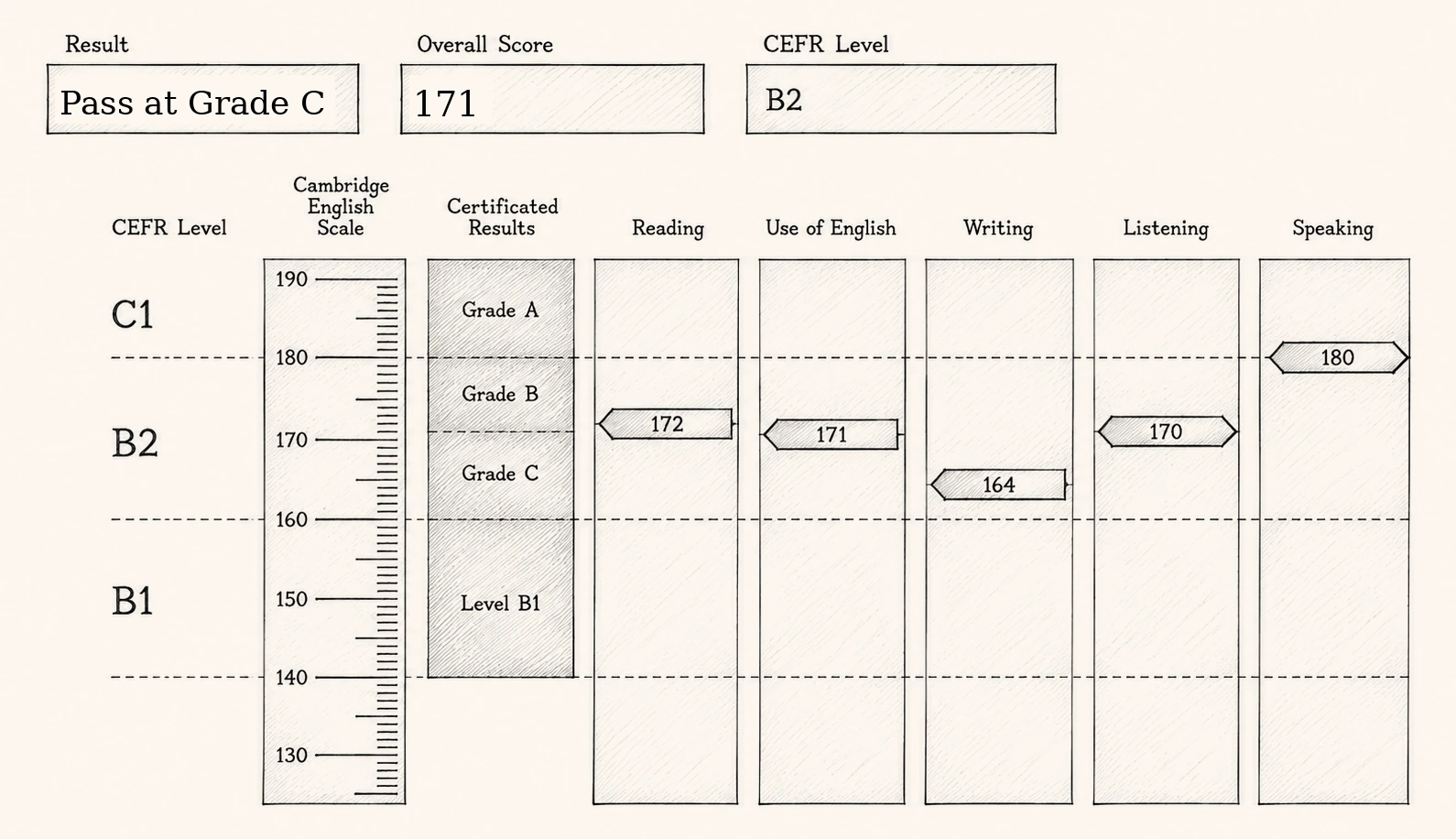
Translation is not a separate component of the B2 First or C1 Advanced examinations. Nevertheless, it trains one of the most important operations those examinations require.
In Key Word Transformations, candidates must preserve the meaning of the original sentence while expressing it through a different structure that includes a given key word. The task tests grammar, vocabulary and collocation — and, above all, the ability to analyse what a sentence actually says and what must not be lost in the new formulation.
A student who has learnt to translate analytically does not merely search for the ‘correct phrase’. First, they identify the temporal relationship, condition, cause, consequence, degree of certainty, emphasised information or perspective of the sentence. Only then do they look for the English construction.
Translation is not a way around Use of English. It is one of the best ways to learn to see what is still missing from a sentence.
The same is true beyond Cambridge examinations. Any format that tests precise writing, paraphrase, argumentation, sentence transformation or grammatical meaning requires the same ability: to understand not only the words, but the relationships between them.
Double Translation: An Old Method for Precise Work
I also use a procedure with a long pedigree.
Roger Ascham, tutor to the future Queen Elizabeth I, described the method of double translation in his 1570 book The Scholemaster. A pupil first translated a text from Latin into English, later translated it back into Latin and then compared this version with the original.
I do the same, only without the Latin.
The student reads a genuine text in the target language: an article from their own field, an interview, a specialist paragraph, an essay or a piece of reportage. It is not an arbitrary textbook passage, but a text whose content matters to them.
We translate it into Czech. After an interval, the student translates the Czech version back into the target language. We then place their text beside the original.
This is not a competition with a native-speaking author. There is no single possible sentence. The point is to compare choices.
Where did the student choose a more precise verb? Where did they copy Czech word order too closely? Where did they lose a shade of meaning? Where, by contrast, did they find their own formulation that is just as good?
This moment is pedagogically valuable precisely because the correction is not detached from context. The student can see their own solution, the original and the specific difference between them.
What the Research Says — and What It Does Not Entitle Us to Claim
A frequently cited study by Batia Laufer and Neomi Girsai compared three approaches to vocabulary and collocation: teaching focused primarily on meaning, form-focused teaching without contrastive comparison, and explicit contrastive analysis using translation. Within that particular research design, the third approach produced the best results for the acquisition of the vocabulary and collocations under investigation.
This is an important finding, but it does not justify claiming that translation is universally the best method for every level, language and objective.
Translation is not a return to the grammar–translation method. It is not a substitute for listening, reading, spontaneous speech or genuine contact with the language.
It is a targeted tool for a particular kind of work: noticing a difference, demanding accuracy, exposing a recurring error and learning to move between two systems more consciously.
This Is Not About Suffering. It Is About Respecting the Work.
Translation can be uncomfortable. Sometimes a student struggles with a single sentence for ten minutes, whereas in conversation they would have worked around it in ten seconds.
That is not a reason to discard translation.
It is a reason to dose it well.
We do not translate pages without a purpose. We work briefly and precisely, using a text that has meaning for the student. A manager might translate an argument from their own field. A doctor might work with a paragraph related to her profession. A school student might translate a text of the kind they need to read and write for their leaving examination.
The aim is not a mark, a percentage or a red pen. The aim is the moment when the student understands: this is the difference between what I wanted to say and what I was able to say so far. And next time, I will be able to say it a little better.
Language does not grow where everything is comfortable. It grows at the edge — and translation into the foreign language is one of the most reliable ways to reach that edge. It blocks the escape route, makes the error visible and demands accuracy.
This does not mean that every lesson must be unpleasant. It means that teaching which removes every obstacle often also removes the place where real growth can begin.
The fact that translation has often disappeared from mainstream teaching tells us nothing definitive about its value. It tells us more about a market that chiefly sells ease, fluency and the immediate sensation of progress.
Conversation teaches us to use a language. Translation shows us where we are still using it only approximately.
Fluency without accuracy leads to stagnation. Accuracy without fluency leads to insecurity.
Language grows where fluency and accuracy meet regularly.