If school offered a subject in which children learned to break a statement down into structure, distinguish the core of a message from its circumstances and understand why the meaning of a sentence changes when we move a single part, parents would welcome it. If it also turned out to make learning foreign languages easier and to develop the ability to argue, we would pay for it as an extra.
That subject already exists at school. It is called sentence analysis. And it is one of the least popular parts of Czech.
That says nothing about children. It says a great deal about how sentence analysis is taught.
What Remains of Analysis Are Labels
Underline the subject with a straight line, the predicate with a wavy line. Identify the object, the attribute, the adverbial. The child learns a procedure, but often does not know what they are actually finding out.
But a sentence is not a set of words, each with its own label. A sentence is a network of relationships: who acts, what happens, whom it concerns, what is the core of the message and what develops it further. These are not questions about abbreviations in a notebook. They are questions about structure.
In good sentence analysis, the child is not mechanically describing anything. They are deciding. They are looking for relationships. That is logical thinking — only school does not call it logic.
The Sentence as Structure, Not a String of Words
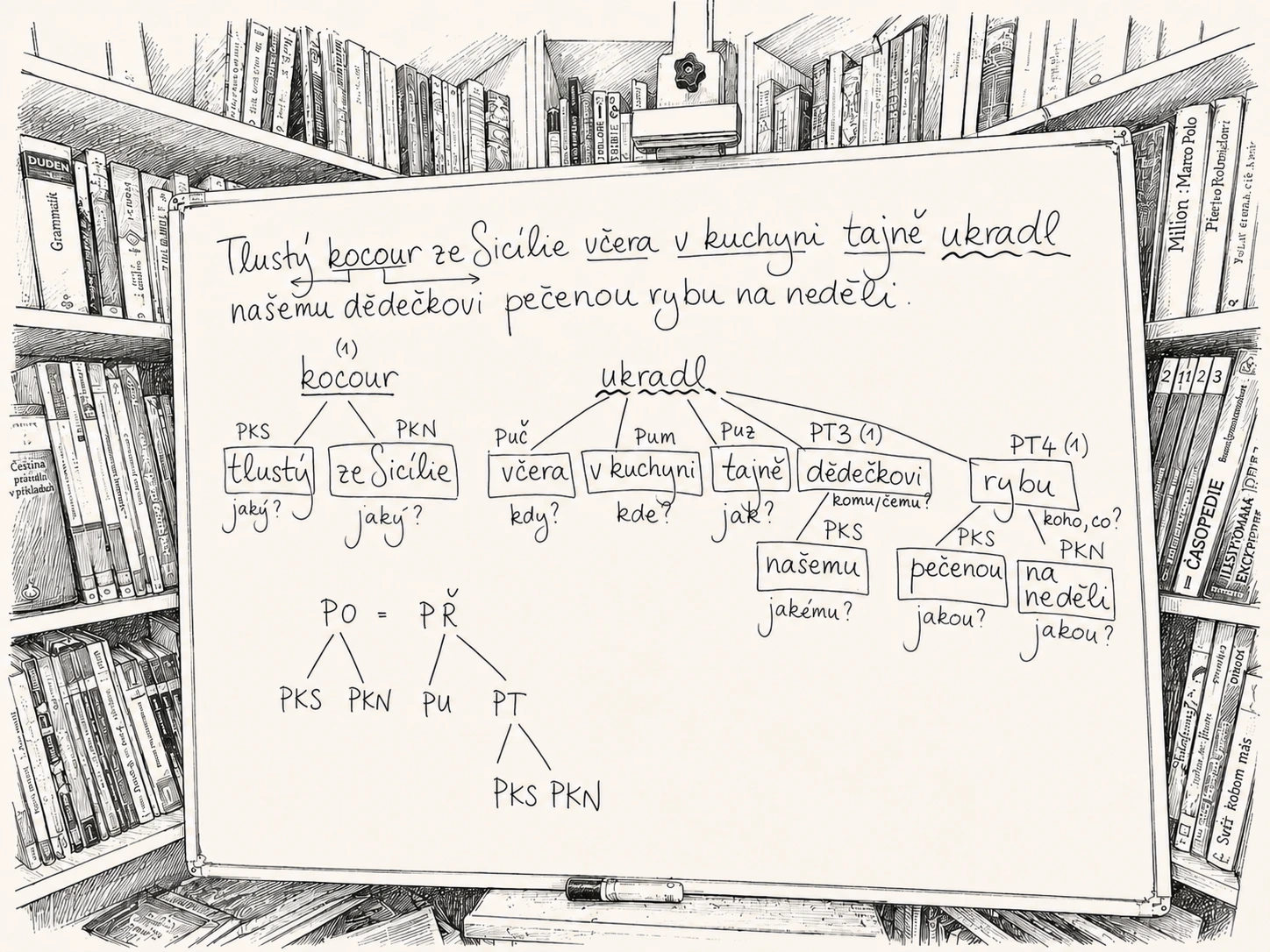
Tlustý kocour ze Sicílie včera v kuchyni tajně ukradl dědečkovi pečenou rybu.
A fat cat from Sicily secretly stole a baked fish from Grandpa in the kitchen yesterday.
The best way to analyse a sentence is like an investigation. We have a perpetrator, an act, the circumstances of the act, the injured party and what was stolen — and the sentence holds all of this in a single structure.
Tlustý kocour ze Sicílie is the perpetrator — and immediately with a profile. Tlustý belongs to kocour. Ze Sicílie does too. And precisely here lies the trap that children most often confuse: tlustý is an adjective, ze Sicílie is a prepositional phrase — two different parts of speech. Yet in the sentence they do the same work: both describe the perpetrator, both are attributes.
A part of speech is the type of material. A sentence constituent is the job that this material performs in the sentence. An adjective is often an attribute, and an adverb is often an adverbial — but that is only a common casting, not the identity of two different things. Similarly, včera, v kuchyni and tajně are three different parts of speech, and yet they do the same work: they specify the circumstances of the act — when, where and how it happened.
What remains is the injured party and the loot. Dědečkovi is the person to whom the damage was done. Pečenou rybu is what disappeared.
Children have this intuition — what belongs together and what work it does — before they know a single name for a sentence constituent. School once deliberately developed it through syntactic pairs; today, it is increasingly the case that a child knows the names of the constituents, but does not see the relationships between them. The terminology remained. The structure was lost.
The Verb as the Centre of the Sentence
The verb opens positions that the sentence has to fill in order to make sense. Ukradl requires three participants: who, to whom, what. The cat — Grandpa — the fish. These three belong to the verb much more tightly than yesterday, in the kitchen or secretly — those are only the circumstances of the act, not its necessary components. This is precisely where the child learns to distinguish the core from the addition.
In linguistics, this property is called valency, and Czech has a strong tradition in its study — there is even an extensive valency dictionary, VALLEX.
The skeleton repeats across completely different sentences. Petr poslal Pavlovi dopis has the same structure as Jana dala psovi paštiku — different words, the same roles: who, to whom, what.
Czech marks these roles through case. Another language entrusts the same work to word order or to a preposition.
From Here, the Path Leads to Argumentation
Sentence analysis is not predicate logic — it does not work with the truth of statements or with quantifiers. But it teaches a similar movement: to separate the relationship from the content, the skeleton from the filling.
Someone who can do this is not forced to accept a sentence as an unanalysable whole. They can ask: what is actually being said here, what is the condition, what is only circumstance or emphasis. Someone who cannot do this is easily taken in by rhetoric — they read advertising, political speech and contracts less well.
No one questions that children need logic — parents pay for chess, programming and critical-thinking clubs. And yet one of the most accessible forms of preparation for structural thinking is already available to children every week directly in Czech. Only they often receive it as Sisyphean work with abbreviations.
Why This Helps in Foreign Languages
A child who sees the sentence as structure does not start from zero in a foreign language. They know that the verb creates a frame and that the roles of the participants — who, to whom, what — remain the same regardless of how a particular language marks them.
The dog bit the man.
The man bit the dog.
The same words, the opposite meaning — because English carries relationships through position, not through endings. In our sentence, the role of Grandpa as recipient is carried in Czech by case; in English it would be carried by a preposition or by position in the sentence.
German shows why the expectation of roles pays off in another way:
Der dicke Kater aus Sizilien hat dem Großvater gestern heimlich in der Küche den gebratenen Fisch gestohlen.
A German sentence cannot be read simply as a Czech sentence with different word order. In second position stands the auxiliary verb hat — and the full lexical verb gestohlen comes only at the end. Between them, the whole scene is gradually assembled: who, to whom, when, how, where and what.
The reader therefore keeps an open frame in their mind: something has happened, but it will be definitively closed only by the final word.
Someone who has practised expecting roles will not get lost. They know that the sentence will need a perpetrator, an action, an affected person, a thing and circumstances, even if they do not arrive in the same order as in Czech. They do not read word by word. They segment the sentence according to relationships.
At the same time, German does not assemble the sentence arbitrarily. It works with the verbal frame, cases, verb position and information structure. We recognise dem Großvater as the affected person through the dative, den gebratenen Fisch as the stolen thing through the accusative. The attribute gebratenen attaches to Fisch and only specifies it more precisely: the fish would remain a fish even without it.
Thanks to cases, Czech has freer word order. German holds the verbal frame more firmly. English carries relationships mainly through position. Three languages, three solutions to the same task. A child who can recognise roles is not learning three isolated systems of prohibitions — they are learning how different languages organise the same world.
What a Parent Can Do with This
It is enough to change the questions. Instead of “identify the attribute”: Which word does this develop? What would remain if we left this part out? What does the verb require? What changes if we reverse the order of the words?
Such work does not bypass school grammar. It restores its meaning.
Sentence analysis should not be abolished. It should be taught as what it really is: the first systematic training in seeing relationships inside language. Not a list of abbreviations. Not a punishment for the fact that a child speaks Czech. A tool that will one day help them understand their own sentence, a foreign language and someone else’s argument.